
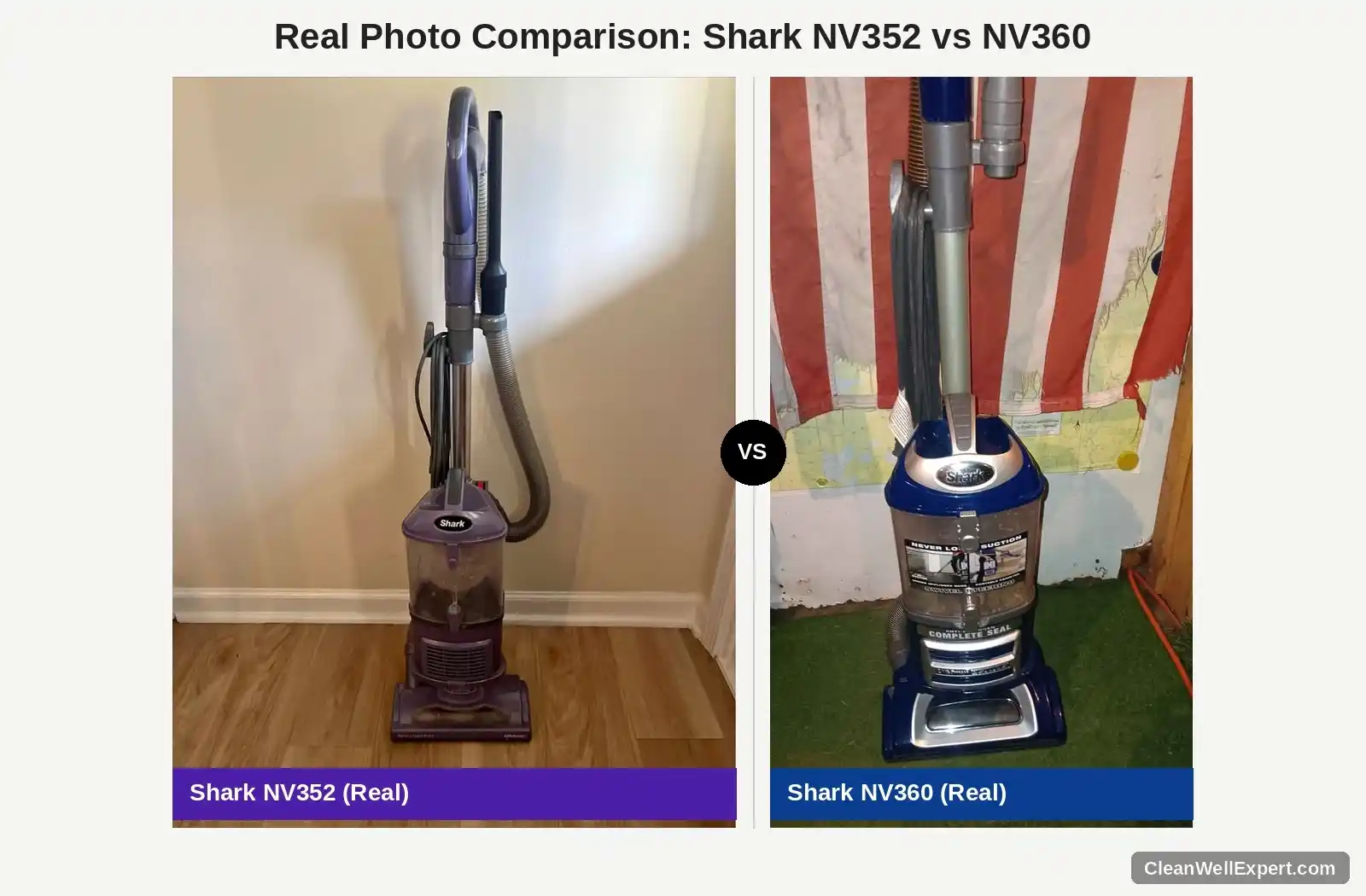
The Shark NV352 and NV360 have the same core cleaning hardware, including a 1,200-watt motor, a 25-foot power cord, a 1.2-quart usable dust cup, and Anti-Allergen Complete Seal technology with HEPA filtration. Neither model has a meaningful suction advantage over the other based on the supplied laboratory figures.
The distinction is in the retail package. The NV352 typically comes in lavender and silver, while the NV360 wears a dark blue finish and is marketed as the Navigator Lift-Away Deluxe. Their included attachments can differ, making the NV360 a potentially better value for homes with pets—but only if the specific package includes the air-driven pet power brush.
I would choose between these two based on the tools in the box and the current price. Paying more for the NV360 solely because it carries the Deluxe name does not make sense.
Technical figures follow the supplied comparison data. Retail bundles can vary, so confirm the actual contents of the listing before buying.
Cleaning Performance: The NV352 and NV360 Are Effectively Tied
The most important finding in this comparison is that neither vacuum has a documented suction advantage over the other. Both use a 1,200-watt, 10-amp motor, and the supplied laboratory figures put both at 89 inches of water lift, with 60 CFM at the motor and 45 CFM at the floor nozzle.
The NV360 does not become a more powerful vacuum simply because Shark calls it Deluxe. The two models share the same basic upright platform, floor head dimensions, and operating controls.
Suction Performance: Does the NV352 Have an Edge?
Both the Shark NV352 and NV360 use a 1,200-watt, 10-amp motor, so their motor ratings alone do not establish a cleaning-performance advantage. The available figures in this comparison list both models at 89 inches of water lift, with 60 CFM at the motor and 45 CFM at the floor nozzle.
I would not claim that the NV352 delivers 3–5% stronger suction without comparable test results showing that difference under controlled conditions. A small variation in an individual test would not automatically prove that the NV352 has a better airflow design or consistently cleans more effectively.
For buyers, the practical takeaway is straightforward: there is no sufficiently verified suction advantage here to justify choosing the NV352 over the NV360 on that basis alone. The included attachments and actual purchase price remain the more useful deciding factors.
Carpet cleaning and suction drag
Both machines use a traditional motorized brush roll. The three-position control provides an off setting, a hard-floor setting with the brush roll off, and a carpet setting with the brush roll running.
That arrangement matters more than the color of the machine. On carpet, the spinning brush roll helps agitate embedded debris. On hard flooring, switching the brush roll off reduces the risk of scattering debris with the rotating bristles.
However, strong suction can create a practical drawback. On thicker or denser carpet, the floor head may feel difficult to push or pull if the nozzle seals tightly against the pile. I would pay particular attention to that resistance when evaluating either model in a home with medium- or high-pile carpet.
Both models have a mechanical Suction Release Collar on the handle. Opening the collar reduces suction when the nozzle feels excessively difficult to move. That is a useful adjustment, but it does not turn either machine into a specialized high-pile carpet vacuum.
My buying advice: If your main concern is carpet pickup, do not pay extra for the NV360 expecting better suction. Choose based on the included tools, the condition of your carpet, and the price.
Hardwood, tile, and area rugs
The brush-roll shutoff gives both vacuums a straightforward way to transition between hard flooring and carpet. I would use the brush roll off on hardwood and tile, then switch it on when moving to rugs and carpet.
The floor head measures approximately 9.5 inches wide. That relatively compact cleaning path can help when navigating around chair legs and other furniture, although it also means more passes are needed to cover a large open floor than with a wider nozzle.
Neither model has LED headlights on the floor head. In dim corners or beneath furniture, I would expect to rely on room lighting rather than a built-in light to reveal dust and debris.
Noise levels
The laboratory measurements show that both models register a base airflow sound of approximately 72 dB on bare floors with the brushroll switched off. However, because hard surfaces reflect sound rather than absorb it, the actual vacuuming experience can produce a high-pitched mechanical roar reaching a maximum peak of 81 dBA.
When moving to carpets and engaging the motorized brushroll (Setting II), the noise levels consistently settle between 78–79 dB due to the bristles agitating the carpet fibers. Because both machines share identical 1,200-watt motor hardware, neither model offers a noise advantage. Expect both to be highly noticeable in enclosed spaces, and neither is a quiet choice if someone nearby is working or sleeping.
Lift-Away Mode: The Feature That Makes Both Models More Versatile
The Lift-Away mechanism separates the motorized pod from the upright body, allowing the user to carry the pod and clean with the hose, wand, and an attachment.
The pod weighs approximately 4.6 pounds. The supplied figure for the complete portable cleaning configuration is approximately 7.6 pounds, depending on the attached components.
That difference matters when cleaning stairs, furniture, and elevated surfaces. Carrying the pod is easier than maneuvering the entire 12.5-pound upright around stair edges, but the portable configuration still requires one hand to support the equipment while the other guides the wand or tool.
I would not describe the Lift-Away setup as weightless or effortless. Holding the pod while reaching across several stair treads can tire the forearm and shoulder, particularly when cleaning above waist height.
The release mechanism is designed for quick conversion between upright and portable cleaning. Both models share this basic arrangement, so the NV360 does not have an inherent advantage in Lift-Away usability.
The hose has practical limits
Both models feature a 5-foot stretch hose. Although its elastic design keeps the vacuum compact during upright storage, it creates a noticeable handling drawback during above-floor cleaning: the hose behaves like a stretched resistance band, constantly pulling back toward the machine.
When I extend the hose 3 to 4 feet while the 12.5-pound vacuum remains upright, the recoil can destabilize the base, especially when I pull sideways or reach overhead. Rather than fighting the hose or risking a toppled vacuum, I would switch to Lift-Away mode and detach the 4.6-pound motor pod before tackling extended stair or above-floor cleaning.
Attachments: The NV352 May Have the Reach Advantage
The most useful accessory difference to check is not simply the number of tools in the box. It is whether the package includes a long, narrow attachment for reaching deep into confined spaces.
Some NV352-compatible configurations include a 24-inch crevice tool, which is useful for reaching along baseboards, inside narrow gaps, and into spaces that a short nozzle cannot easily access. SharkNinja lists a 24-inch crevice tool as compatible with the NV352, although compatibility does not guarantee that it comes in every retail package.
That extra reach can be particularly useful when cleaning beside a refrigerator or deep along the side of a cabinet. I would check the accessory list before buying rather than assume the tool is included.
The NV360 Deluxe is associated with accessories such as a pet power brush and an appliance wand, depending on the configuration. Its owner’s documentation lists an appliance wand among the available accessories. The standard extension wand, however, is also compatible with both the NV352 and NV360, so it should not be presented as an exclusive NV352 advantage.
For pet owners, the NV360 package may offer better value if it includes the air-driven pet power brush. For cleaning deep, narrow gaps, the NV352 may be the more attractive purchase if its specific bundle includes the longer crevice tool and the NV360 bundle does not.
My recommendation: Compare the actual tools listed for each retailer’s SKU. A 24-inch crevice tool, an appliance wand, and a standard extension wand serve different purposes; their names and lengths should not be used interchangeably.
Dust Capacity and Filter Maintenance
Both models have a usable dust capacity of approximately 1.2 dry quarts up to the Max Fill line.
That is adequate for routine cleaning, but households with multiple shedding pets may need to empty the cup frequently. I would empty it before the debris reaches the maximum fill line rather than waiting for the chamber to become tightly packed.
Fine dust can cling to plastic surfaces through static, and long hair can collect around the internal cyclone. Emptying the cup may therefore involve more than simply opening the bottom door. Depending on the debris, you may need to remove trapped material manually.
For a less messy routine, I would empty the cup over a trash can, keep my face away from the opening, and avoid shaking the contents aggressively.
HEPA Filtration: What the Specifications Mean for Maintenance
Both the Shark NV352 and NV360 use a pre-motor foam and felt filter kit identified as XFF350 and a pleated post-motor HEPA filter identified as XHF350. However, the two filter types require different maintenance procedures.
The foam and felt pre-motor filters can be washed with cold water according to the applicable owner’s manual. Allow them to air-dry completely for at least 24 hours before reinstalling them. Never reinstall damp filters.
The pleated HEPA filter (XHF350) requires an entirely separate, dry-only care routine. Contrary to some older retail descriptions, this pleated paper filter is strictly non-washable and must never be exposed to water, which instantly ruins its delicate, fibrous micro-structures. Instead, tap it gently with the dirty side facing down inside a trash can once every 12 months to dislodge fine allergens, and replace the cartridge completely every 2 years.
Proper filter maintenance helps preserve airflow and the performance of the Anti-Allergen Complete Seal system. If suction decreases, check the filters for accumulated debris, inspect the air pathways for blockages, and make sure all components are correctly installed.
Long-Term Ownership: The Problems Worth Watching
The two models share the same basic design, so their common maintenance requirements are more relevant than their cosmetic differences.
Hair wrap around the brush roll
Neither model uses an actively self-cleaning brush-roll system. Long hair and pet fur can wrap around the brush roll, reducing its ability to agitate carpet and potentially interfering with rotation.
I would inspect the brush roll regularly in a household with long-haired occupants or shedding pets. Cut away wrapped hair carefully with scissors, following the manual’s safety instructions, and disconnect the vacuum from power before performing maintenance.
Do not assume the NV360’s pet-oriented accessory bundle means its main floor brush is tangle-free.
The lower base hose deserves inspection
The short hose near the floor head is exposed to repeated bending as the cleaner head turns. Over time, wear or damage to this section can allow air to leak, reducing suction at the nozzle even when the motor continues to run.
A failure after 10–12 months should not be treated as a guaranteed service-life prediction; actual durability depends on use, handling, and the condition of the individual machine. Nevertheless, I would inspect the hose periodically for cracks, splits, and visible damage.
If suction suddenly falls while the motor still sounds normal, check for a full dust cup, clogged filters, blocked passages, and damaged or disconnected hoses before assuming the motor has failed.
Upright stability when using the hose
The stretch hose can exert enough tension to pull against the upright body when extended. Reaching too far sideways or overhead increases the chance that the machine will tip.
My preferred approach would be to bring the vacuum closer to the cleaning area or use Lift-Away mode for extended above-floor work. That reduces the temptation to stretch the hose beyond a comfortable range.
No LED headlights
Both models lack floor-head LED lighting. This is a minor omission in a bright room but a genuine inconvenience under beds, sofas, and other low-clearance furniture.
If you regularly vacuum dark spaces, I would keep a separate light handy or consider a newer model with illuminated floor cleaning if that feature matters to you.
I would make the final decision based on the following priorities rather than treating the Deluxe label as an automatic upgrade.
Buy the Shark NV352 if:
- You want the same core motor and cleaning platform at a lower price.
- Your main tasks are cleaning carpets, hard floors, stairs, and everyday household debris.
- You prefer the lavender-and-silver finish.
- The standard attachments cover your needs.
- The NV352 is meaningfully cheaper than an NV360 package with equivalent tools.
Buy the Shark NV360 if:
- You prefer the dark blue finish.
- The exact package includes the air-driven pet power brush.
- You regularly clean pet hair from sofas, cushions, and other upholstered surfaces.
- Its price is close enough to the NV352 that the additional tools justify the difference.
Skip the upgrade if the only difference is the name
I would not pay a substantial premium for the NV360 solely because it is marketed as Deluxe. The supplied specifications show the same motor rating, suction measurements, airflow, floor-head dimensions, dust capacity, weight, cord length, and filtration system.
If both boxes contain essentially the same tools, I would buy whichever model costs less, provided the retailer, warranty, and return policy are comparable.
Final Verdict
The Shark NV352 is the value pick; the Shark NV360 is the conditional accessory pick.
Neither has a meaningful advantage in the core cleaning hardware based on the supplied figures. Both offer Lift-Away versatility, brush-roll control for hard floors and carpet, a 25-foot cord, and sealed HEPA filtration.
The NV352 makes more sense when its standard tools meet your needs and it costs less. The NV360 becomes more attractive when its particular retail bundle includes the air-driven pet power brush and you will use that tool regularly.
Before placing an order, I would verify the included accessories against the exact product listing. That single check is more useful than paying extra for the Deluxe name alone.