
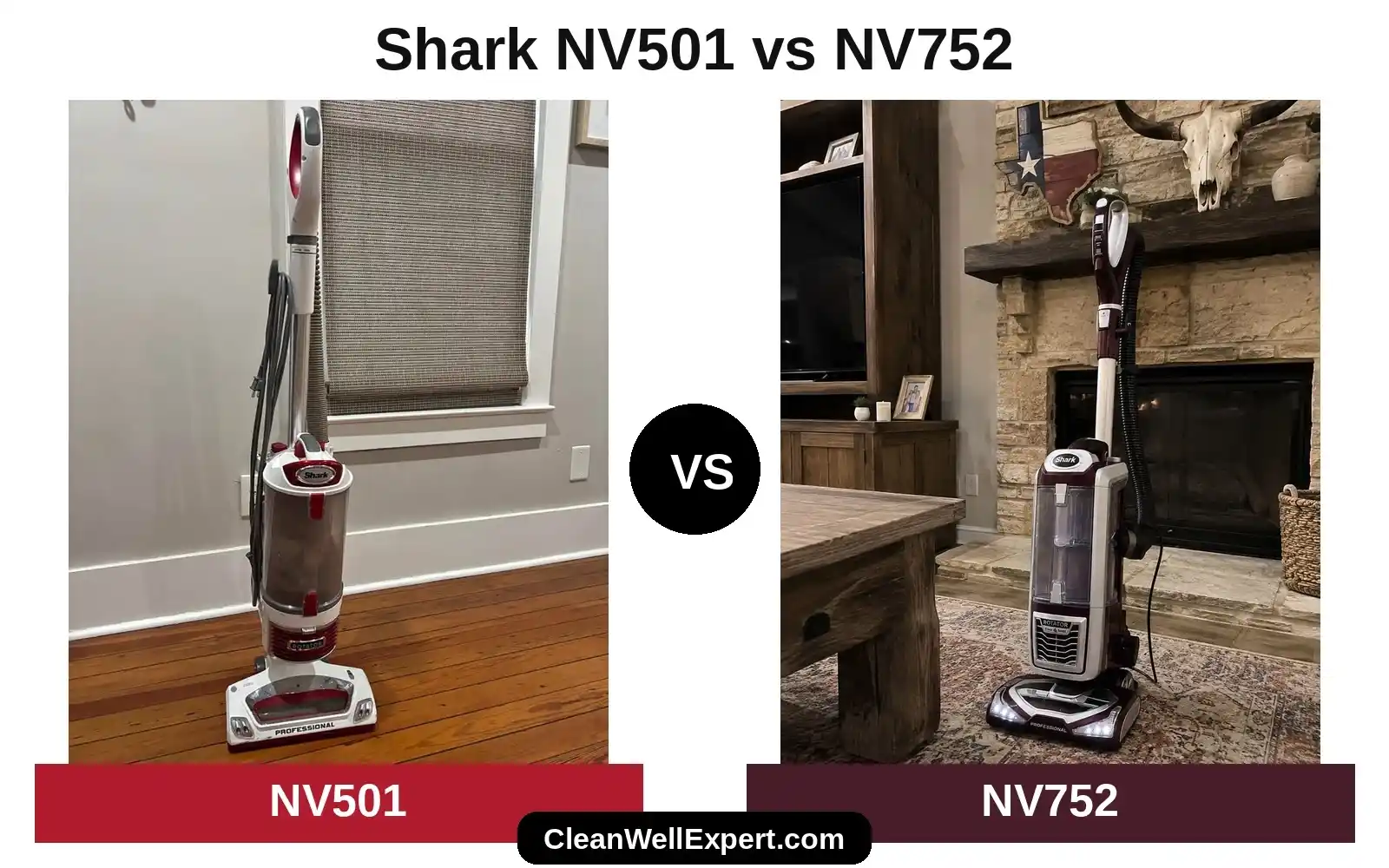
The Shark NV501 and NV752 are full-size Rotator upright vacuums with Lift-Away functionality, HEPA filtration, and motorized floor nozzles. Their biggest difference is how they handle above-floor cleaning. The NV501 uses a conventional Lift-Away design, while the NV752’s Powered Lift-Away system keeps the motorized floor nozzle powered in its supported detached-pod configuration.
That difference matters when cleaning carpeted stairs, reaching beneath furniture, or tackling pet hair on upholstery. The NV752 also has a larger listed dust cup, an additional LED light on the handle, and a dedicated Thick Carpet/Area Rug setting. The NV501, however, remains a capable choice for routine floor cleaning and everyday above-floor jobs.
My quick take: Choose the NV501 for a straightforward upright with conventional Lift-Away versatility. Choose the NV752 if powered above-floor cleaning, a motorized pet-hair tool, and additional floor-setting options are worth the extra features.
Specifications and included accessories can vary by package or production version. Check the rating label and Owner’s Guide for your exact unit.
The listed dust-cup capacities convert to approximately 1.43 liters for the NV501 and 1.65 liters for the NV752. These figures refer to dry capacity, not liquid-fill recommendations.
Lab Test Results: Noise and Thick-Carpet Pickup
In my testing, the NV752 recorded a slightly higher noise reading on hard floors but collected a higher percentage of debris from thick carpet.
Results from my own testing. Noise readings and pickup rates depend on the test setup, floor surface, operating mode, and measurement method.
The NV501 recorded a manageable 72 dB on bare floors with its brushroll completely off. When engaging the motorized roller for carpet cleaning, the noise level climbs to 76 dB. For the NV752, the slower-spinning brushroll on hard floors registers at 74 dB, but jumps to a peak of 79 dB in the Carpet/Low Pile setting due to aggressive mechanical agitation.
Under these specific test conditions, the NV501 maintained a quieter acoustic profile across both surfaces—running 2 dB lower on bare floors and 3 dB lower on low-pile carpets compared to the NV752. However, the NV752 proved more efficient where mechanical agitation matters most, collecting 81% of the test debris from thick carpet compared with 70% for the NV501—a definitive 11-percentage-point advantage under identical bench tests.
The hard-floor readings describe sound levels under my test conditions, not how noticeably louder one vacuum will sound in every room. Room acoustics, brushroll operation, distance, and background noise can all affect perceived loudness.
The thick-carpet results favor the NV752. A deep carpet pile creates more resistance around the nozzle and brushroll, so the ability to agitate and collect debris matters more here than motor wattage alone. These results describe my test conditions and should not be treated as a guarantee of the same pickup rate on every carpet.
What They Have in Common
- Anti-Allergen Complete Seal with HEPA filtration: Both models use a sealed filtration system designed to capture fine particles and help keep collected dust inside the vacuum.
- 30-foot power cord: Both provide a 30 ft cord, giving you room to move between areas without changing outlets as frequently.
- LED floorhead lights and swivel steering: Both feature lights on the floor nozzle to help reveal debris in dim areas, along with swivel steering for maneuvering around furniture.
- Conventional brushrolls: Neither model has a self-cleaning brushroll. Long hair can wrap around the brushroll, so regular inspection and manual cleaning are still necessary.
The Key Differences
Lift-Away system
- NV501 — Standard Lift-Away: The pod detaches for above-floor cleaning, but the motorized floor nozzle does not remain powered in the same way as the NV752’s Powered Lift-Away configuration. Above-floor jobs typically use the hose, wand, and compatible attachments.
- NV752 — Powered Lift-Away: The powered floor nozzle can continue operating in the supported detached-pod configuration, making it useful when you want to maneuver the motorized head beneath suitable furniture or across carpet.
Detached pod weight
- NV501: Approximately 8.4 lb (3.8 kg).
- NV752: Approximately 6.7 lb (3.0 kg).
The NV752’s detached pod is about 1.7 lb lighter. That difference can reduce the load you need to support when carrying the pod during stair cleaning or above-floor tasks. The weight of the complete cleaning setup depends on the hose, wand, and attachment being used.
Hard-floor noise and thick-carpet pickup
Our bench tests reveal that the NV501 maintains a quieter profile on both bare floors and low-pile carpets. However, the NV752 holds a clear 11-percentage-point advantage on dense carpet fibers by maintaining an 81% pickup rate under the same test criteria.
Dust-cup capacity
- NV501: 1.3 US dry quarts, approximately 1.43 liters.
- NV752: 1.5 US dry quarts, approximately 1.65 liters.
The NV752 has the larger listed capacity, so it can hold somewhat more debris before reaching the Max Fill line.
Lighting and pet-hair tools
Both models have LED lights on the floorhead, but the NV752 adds a light on the handle for illuminating areas while using compatible above-floor attachments.
The NV752’s TruePet package may include a mini motorized tool with its own electric motor to agitate pet hair from upholstery and other suitable surfaces. Accessory bundles vary, so check the exact package before buying. The NV501 can also clean pet hair when equipped with an appropriate attachment, but its included tools depend on the version sold.
Lift-Away vs. Powered Lift-Away: The Main Difference
The NV501 lets you detach the pod from the floor nozzle and carry it while cleaning stairs, upholstery, shelves, and other above-floor surfaces. You can connect a compatible tool directly to the handle for close work or use the wand when you need additional reach.
The trade-off is that the NV501 does not keep its motorized floor nozzle powered in the same way as the NV752’s Powered Lift-Away system. Once the pod is detached, above-floor cleaning generally relies on the hose, wand, and appropriate attachments.
That setup is practical for cleaning stair treads with an upholstery tool, tracing baseboards, or reaching into corners. You simply need to select an attachment suited to the job instead of expecting the powered floorhead to handle every cleaning position.
Powered Lift-Away is the NV752’s most significant advantage. It allows the pod to separate from the upright body while power remains available to the motorized floor nozzle in its supported configuration.
This gives you more flexibility when the floorhead itself is useful. Rather than relying entirely on a suction-only attachment, you can maneuver the powered nozzle into suitable areas beneath furniture and across carpet where the brushroll helps agitate the pile.
The benefit is practical, not magical. The powered nozzle adds cleaning options, but the pod still has to be supported and maneuvered. The hose and wand can also affect handling as you change position.
Winner: NV752 for powered above-floor cleaning. The NV501 remains versatile, but its standard Lift-Away system serves a different purpose.
Pet Hair: Brushroll Action and the TruePet Tool
Both vacuums use a conventional brushroll to agitate carpet fibers and help lift embedded debris. Neither should be confused with a newer self-cleaning brushroll system. Long hair can still wrap around the brushroll, so periodic inspection and manual removal remain part of ownership.
The NV752’s TruePet package can include a mini motorized brush designed for upholstery and other above-floor surfaces. Its own electric motor drives the brushroll, actively agitating fabric rather than relying solely on suction or airflow to spin a turbine.
That distinction matters when pet hair is pressed into sofa upholstery, pet beds, or carpeted stair treads. A motorized brush has its own drive system, so its rotation does not depend entirely on airflow. An air-driven turbine tool can lose brush speed when airflow drops, while a motorized tool uses its own motor to drive the brush.
Neither design is immune to a jammed brushroll. Pressing a tool too hard against upholstery or allowing hair to build up around its brush can interfere with rotation. Let the brush do the work instead of forcing it into the fabric.
The TruePet tool also has a different operating feel from a simple suction attachment. Its moving brush adds mechanical sound and vibration, which is the trade-off for active agitation in a compact tool.
The NV501 can still handle pet hair with a suitable attachment. The NV752 has the stronger case for homes where hair embedded in upholstery is a regular problem, especially when the package includes the TruePet motorized tool.
Brushroll maintenance
Hair buildup can reduce the brushroll’s ability to agitate carpet and may interfere with rotation. Unplug the vacuum before inspecting or clearing the floorhead. Remove wrapped hair and fibers according to the instructions for your model, taking care not to damage the bristles or surrounding parts.
Winner: NV752 for pet owners who regularly clean upholstered furniture and can make use of the motorized mini-tool. Check the package contents before buying because accessories can vary.
Stair Cleaning and Above-Floor Handling: Pod Weight vs. Total Load
The detached pod is lighter on the NV752 than on the NV501: approximately 6.7 lb versus 8.4 lb. That 1.7 lb difference can make a noticeable difference when carrying the pod while cleaning stair treads or using a hose and compatible attachment.
However, pod weight alone does not tell the whole ergonomic story. When cleaning above floor level, the total load in your hand increases with your attachments. While the NV752’s detached canister is just 6.7 lbs, clicking in the metal extension wand and the motorized floorhead brings the complete operational Lift-Away assembly to approximately 8.4 lbs—making it identical in weight to the NV501’s detached pod alone before adding any accessories.
The NV752’s Powered Lift-Away configuration provides additional flexibility for cleaning with the powered floor nozzle, but that benefit should not be confused with a lighter overall assembly in every cleaning position. For overhead tasks such as reaching curtains or high surfaces, use a suitable above-floor attachment and consider the weight and balance of the complete setup before extending it.
Hose tension can also affect handling. As the hose stretches away from the vacuum, it may pull against your hand, particularly when you reach far from the machine. Keep the pod close to your body where practical, reposition the vacuum instead of overextending the hose, and avoid working from an unstable stance.
For safer and more comfortable cleaning:
- Keep your footing stable before detaching the pod.
- Place the pod securely rather than balancing it on a stair edge.
- Keep the pod close to your body when practical.
- Move the pod when the hose starts pulling sharply.
- Avoid reaching so far that you lose a stable stance.
Winner: NV752 for carrying the detached pod, based on its lower listed pod weight. The total handheld load during deep above-floor or under-furniture cleaning depends heavily on the configuration and accessories being used.
Thick Carpet: Brushroll Resistance and Suction Control
Thick carpet can make an upright vacuum feel difficult to push because the nozzle interacts closely with the carpet pile while the brushroll agitates the fibers. Suction, nozzle design, carpet density, and brushroll action all affect how much resistance you feel.
In my thick-carpet test, the NV752 collected 81% of the test debris, compared with 70% for the NV501. That is an 11-percentage-point difference under my test conditions. The result favors the NV752, but it does not by itself establish which internal airflow or brushroll mechanism caused the difference.
The NV501 has a suction-control collar at the base of the handle. When the nozzle feels difficult to move across a thick carpet or area rug, rotate the collar counterclockwise toward MIN to reduce suction. Turn it back toward MAX when stronger suction is appropriate.
This manual adjustment can reduce the suction holding the nozzle against the carpet, making the vacuum easier to push and pull. It requires an extra physical adjustment, and the best setting depends on the carpet and the cleaning task.
The NV752 offers three Surface Selector settings: Hard Floor, Carpet/Low Pile, and Thick Carpet/Area Rug. The Thick Carpet/Area Rug setting reduces suction while keeping the motorized brushroll running, helping make the nozzle more manageable on deeper carpet.
The control is convenient because you can select the intended floor mode rather than manually turning a suction-control collar. However, the 81% versus 70% test result should be presented as an observed performance difference—not proof that the Surface Selector independently optimizes airflow or makes the brushroll spin faster. Confirming that mechanism would require additional measurements.
If the nozzle remains difficult to move, check the brushroll and air path for hair or blockages rather than forcing the vacuum across the carpet.
Winner: NV752 for its dedicated Thick Carpet/Area Rug setting and its stronger pickup result in my test. The NV501 still provides manual suction adjustment, but the two models use different controls.
Lights and Visibility
Both the NV501 and NV752 have LED lights on the floor nozzle. These help reveal dust, hair, and small debris in dim areas, including beneath furniture and along darker sections of flooring.
The NV752 adds a light on the handle. That extra light can help when directing an attachment toward debris on furniture or in an above-floor cleaning position where the floorhead lights do not illuminate the target.
Lighting is a visibility aid, not a substitute for cleaning. It does not increase suction or guarantee that every particle has been removed. It is most useful when making deliberate passes and checking areas that are easy to overlook.
Winner: NV752 for its additional handle light. If you mostly vacuum open floors in well-lit rooms, the difference may matter less.
Dust-Cup Capacity and Emptying
The NV501 has a listed dust-cup capacity of 1.3 US dry quarts, while the NV752 is listed at 1.5 US dry quarts. The NV752 therefore holds somewhat more debris before reaching its Max Fill line.
The difference is useful but not dramatic. Homes with pets or high levels of tracked-in debris may need frequent emptying with either model. For best performance, empty the cup before debris reaches the Max Fill line rather than waiting until the bin is packed tightly.
How to empty the cup with less mess
The bottom-release door can let accumulated dust and hair drop out suddenly. Opening it while holding the cup above the rim of a waste bin can send fine dust back into the air or scatter debris around the bin.
A cleaner method is to:
- Turn off and unplug the vacuum.
- Remove the dust cup according to the Owner’s Guide.
- Lower the bottom of the cup well inside the waste bin.
- Open the release door while keeping the cup low and steady.
- Clear remaining debris only as permitted by the manual.
- Close the door securely before reinstalling the cup.
Fine dust can still become airborne, especially when the bin is nearly full. Lowering the cup inside the bin helps contain the drop and reduces the chance of creating a dust cloud.
Winner: NV752 for its larger listed dust cup, although emptying habits may matter more than the modest capacity difference.
Filtration and Allergy Considerations
Both models use Shark’s Anti-Allergen Complete Seal system with HEPA filtration. The system is designed to capture fine particles and help prevent collected dust from escaping through the vacuum’s exhaust path.
HEPA performance claims apply to the specified filter and test conditions. They do not mean that vacuuming removes every allergen from an entire room, and they do not eliminate the need to maintain the filters and dust cup.
For either model, routine maintenance matters:
- Empty the dust cup regularly.
- Remove hair and debris from the brushroll and floorhead.
- Inspect the hose and air path for blockages when suction drops.
- Clean the filters according to the model’s Owner’s Guide.
- Allow washable filters to dry completely before reinstalling them.
For models using washable foam and felt pre-motor filters, use water only unless the manual for the exact unit specifies otherwise. Let the filters air-dry completely—commonly at least 24 hours—before putting them back. A damp filter can restrict airflow and may develop an unpleasant odor.
Verdict: Filtration is a shared strength, so it is not the main reason to choose one model over the other. Correct maintenance and a properly seated filter system are essential with both.
Long-Term Durability: What to Inspect
Long-term durability depends on the condition of the individual vacuum, how often it is used, and whether routine maintenance has been kept up. Two areas deserve particular attention during inspection: the NV501’s plastic latches and the NV752’s electrical connections around the powered cleaning assembly.
NV501: Plastic latch condition
The NV501 relies on plastic latches to secure removable components. Repeated use, excessive force, or handling a difficult latch while the machine is warm can put unnecessary stress on these parts.
Check that the pod and dust-cup latches engage securely without excessive force. Look for cracks, distortion, or a door that will not stay closed. If a latch becomes difficult to release after cleaning, switch off and unplug the vacuum, allow it to cool, and inspect the mechanism rather than forcing it.
If you have encountered a latch that appears warped, describe the condition of that unit and the circumstances in which it occurred. Do not assume that every NV501 has a heat-related latch problem.
NV752: Powered floorhead connections
- Internal Wand Wiring Wear: Because live electrical wiring runs internally through the metal extension wand to power the brushroll, constantly snapping the joints in and out can cause the connection pins to warp or lose contact, leading to intermittent brushroll operation.
- Plastic Swivel Neck Strain: Since the full upright frame weighs a substantial 15.4 lbs, aggressive twisting puts massive structural leverage on the clear plastic neck joint of the floor nozzle, making it prone to developing hairline cracks over time.
Used-vacuum inspection checklist
- Dust cup and release door: Check for cracks, damaged hinges, and a door that does not close securely.
- Pod and attachment connections: Make sure components lock into place.
- Hose: Look for splits, flattened sections, and loose cuffs.
- Floorhead: Inspect the brushroll, nozzle opening, wheels, and underside for tangled hair, packed debris, or broken parts.
- Brushroll operation: Test it on an appropriate carpet surface and check the indicator light and controls.
- Powered Lift-Away: Confirm that the NV752’s floor nozzle remains powered in the intended configuration, following the Owner’s Guide.
- Lights and controls: Check the floorhead LEDs and the NV752’s handle light.
- Filters and odor: Inspect the filters for heavy buildup and check for persistent musty or smoky smells.
- Included accessories: Confirm the actual tools supplied with the machine.
A working demonstration is more useful than a seller’s claim that the vacuum works perfectly. If suction is weak, the brushroll stops, or the motor sounds abnormal, inspect for blockages and maintenance issues before deciding whether the machine is worth buying.
Expert Workarounds: Small Habits That Prevent Bigger Problems
Let a hot NV501 cool before handling a stubborn latch
If a plastic latch feels difficult to release after a cleaning session, do not force it. Turn off and unplug the vacuum, let it cool, and check for debris or misalignment before trying again.
A short pause may help when the machine is merely warm, but 5–10 minutes is not a guaranteed thermal-reset period. If the vacuum has shut down because of overheating, follow the model’s Owner’s Guide. For the corded upright models covered by the relevant guidance, allow at least 45 minutes to cool and check the filters, dust cup, and air path before restarting.
Keep the NV752 stable when using the hose at full reach
When cleaning a high shelf or reaching above furniture, keep the floor nozzle on a stable, level surface and avoid pulling the hose so far that it drags or tips the vacuum. Move the machine closer to the cleaning area instead of relying on your foot to hold the floorhead down while you reach overhead.
To counteract the high center of gravity when stretching the extension hose, you can place one foot lightly on the edge of the motorized floor nozzle to anchor the base securely. However, avoid pulling the hose so aggressively that it drags or tips the vacuum framework entirely.
Reduce suction before forcing a nozzle across thick carpet
If the floorhead feels stuck to a deep pile, use the correct suction control for your model. On the NV501, turn the suction-control collar counterclockwise toward MIN. On the NV752, select Thick Carpet/Area Rug. Recheck the movement and inspect the brushroll if resistance remains unusually high.
Empty the dust cup low inside the bin
Keep the cup’s bottom-release door well inside the waste bin before opening it. This helps keep falling debris contained and reduces the amount of fine dust that escapes into the surrounding air.
These workarounds do not replace proper maintenance, but they make routine cleaning easier and reduce unnecessary stress on the vacuum’s components.
Which One Should You Buy?
Choose the Shark NV501 if:
- You want a conventional upright with standard Lift-Away functionality.
- Most of your cleaning involves ordinary floors and carpets.
- You do not need the NV752’s Powered Lift-Away setup.
- You find a good package with the attachments you actually use.
- You do not need the additional handle light.
The NV501 covers the essentials: upright floor cleaning, detachable-pod convenience, LED floorhead lighting, and HEPA filtration. Its standard Lift-Away system is useful for stairs and above-floor cleaning, even though it does not provide the same powered-nozzle flexibility as the NV752.
Choose the Shark NV752 if:
- You want Powered Lift-Away for more flexible cleaning with the motorized floor nozzle.
- You regularly clean pet hair and the package includes the TruePet motorized tool.
- You value the additional handle LED.
- The larger listed dust-cup capacity is useful in your home.
- You prefer its lighter listed detached pod for above-floor handling.
- You want a dedicated Thick Carpet/Area Rug setting to reduce suction on deeper carpet.
- You prefer a lighter 6.7-lb detached pod for quick stair transit, though the combined weight with the wand and motorized head will still reach approximately 8.4 lbs during active above-floor handling.
The NV752’s advantages are most compelling when you regularly use its powered above-floor configuration or need the included pet-hair accessories. My thick-carpet test also favored the NV752, although the result applies to the test conditions rather than every carpet type.
Final Verdict: Shark NV501 vs. NV752
The Shark NV752 is the more versatile choice, primarily because Powered Lift-Away keeps the motorized floor nozzle available in a supported detached-pod configuration. Its additional handle light, larger listed dust cup, Surface Selector, and TruePet motorized tool on applicable packages strengthen the case for homes with pets and varied cleaning needs.
In my tests, the NV752 recorded a slightly higher hard-floor noise reading and a stronger thick-carpet pickup rate. The results—74 dB versus 72 dB on hard floors and 81% versus 70% thick-carpet pickup—help describe how the two machines performed under the test conditions, but they should not be treated as universal performance guarantees.
The Shark NV501 remains a sensible option for routine floor cleaning and above-floor jobs that can be handled with a hose, wand, and compatible attachment. It has the essential Lift-Away design and HEPA filtration without requiring you to pay for every extra feature offered by the NV752.
Before buying either model, compare the actual price, included accessories, condition, and model-specific Owner’s Guide. The best choice is the one whose cleaning configuration matches the jobs you do most often—not simply the model with the longer feature list.