
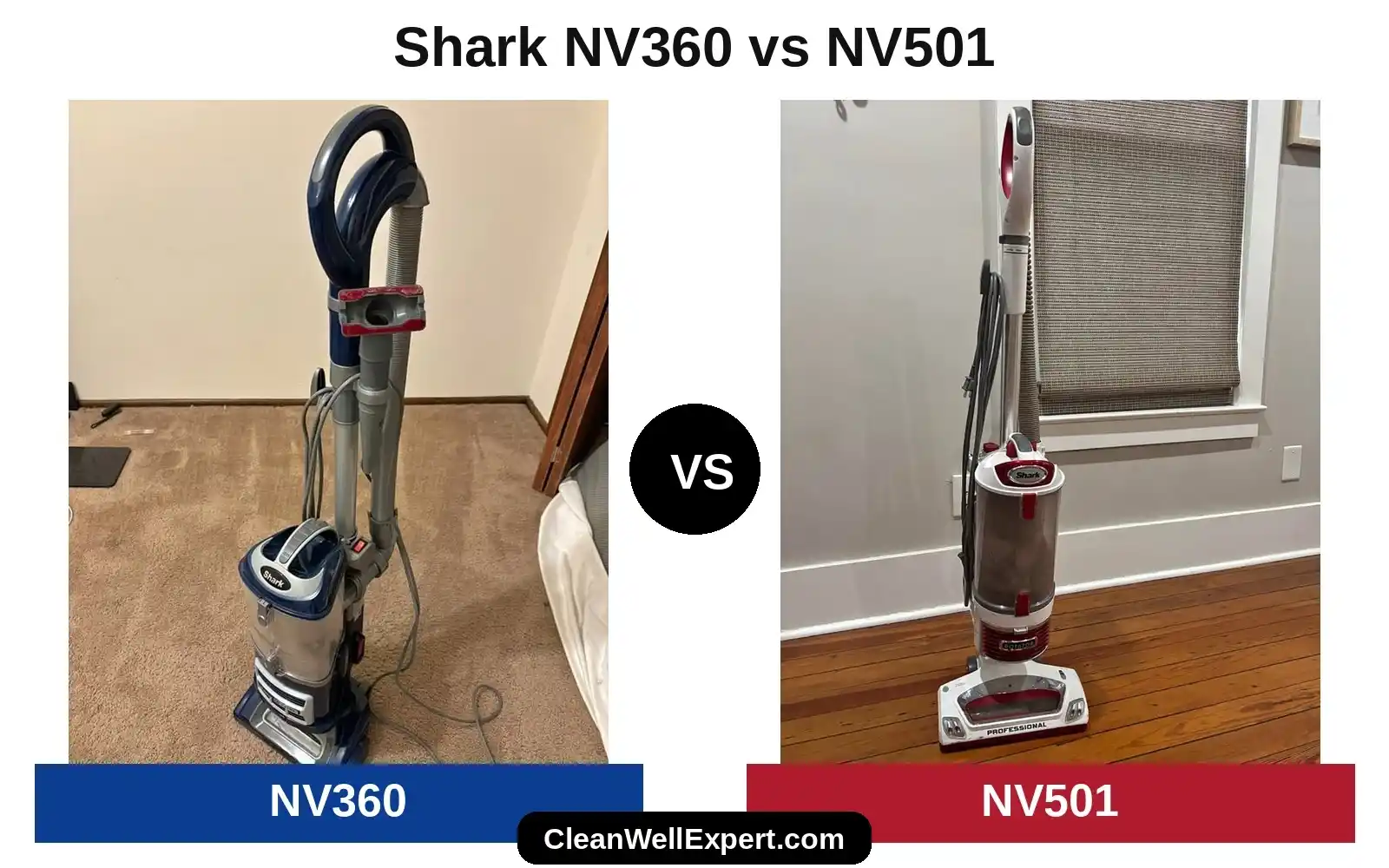
The Shark NV360 is the better choice for buyers who prioritize lighter handling and straightforward everyday cleaning, while the Shark NV501 offers more convenience for thick carpets, dark corners, and larger cleaning areas. In the CleanWellExpert laboratory results supplied for this comparison, the NV360 collected 92% of test debris from low-pile carpet and 62% from high-pile carpet. The NV501 collected 93% and 70%, respectively. These percentages describe the reported test conditions, not a guaranteed result on every carpet or in every home.
The difference is small on low-pile carpet but more noticeable on high-pile surfaces. The NV501 also has LED headlights, a 30-foot power cord, and a dedicated suction-control collar. The NV360 weighs less in its upright configuration and may be easier to handle when steering around furniture or carrying the machine between floors.
I would not choose either vacuum based on pickup figures alone. I would also consider how firmly the floorhead grips a thick rug, how much effort it takes to support the detached pod on stairs, whether I can spot debris under furniture, and how much maintenance the machine may need over time.
| Feature | Shark Navigator NV360 | Shark Rotator NV501 |
|---|---|---|
| Product line | Navigator Lift-Away Deluxe | Rotator Professional Lift-Away |
| Design | Upright with detachable Lift-Away pod | Upright with detachable Lift-Away pod |
| Upright weight | About 12.5 lbs in supplied comparison data | About 15.5–15.8 lbs in supplied comparison data |
| Detached pod weight | About 7.6 lbs | About 8.4 lbs |
| Dust cup capacity | 0.9 qt to the fill line | About 1.3 dry qt reported as total volume |
| Floorhead LED lights | No | Yes |
| Power cord | 25 feet | 30 feet |
| Swivel steering | Yes | Yes |
| Brushroll shutoff | Yes | Yes |
| Sealed HEPA filtration | Yes | Yes |
| Suction adjustment | Suction-release collar | Suction-control collar |
| Low-pile carpet pickup | 92% in reported CleanWellExpert testing | 93% in reported CleanWellExpert testing |
| High-pile carpet pickup | 62% in reported CleanWellExpert testing | 70% in reported CleanWellExpert testing |
| Hard-floor noise | 72 dB in supplied test data | 72 dB in supplied test data |
| Carpet noise | 78 dB in supplied test data | 76 dB in supplied test data |
| Brushroll maintenance | Traditional brushroll | Traditional brushroll with reported built-in scissor groove |
| Main advantage | Lighter upright configuration and straightforward operation | LED lighting, longer cord, and additional suction adjustment |
| Reported long-term concern | Splitting of the lower base hose | Increasing resistance in the red Lift-Away latch |
Testing note: The laboratory percentages, weights, noise readings, and durability observations are attributed to the CleanWellExpert comparison information supplied for this article. Dust cup capacities use different measurement descriptions and should not be treated as directly equivalent without confirming the measurement methods. Shark’s official NV360 listing specifies a 0.9-quart dust cup and a 25-foot cord. Reported durability observations should be understood as observations from the cited testing, not as a failure rate for all units.
Design and Maneuverability: The NV360 Is Easier to Handle as an Upright
Both vacuums combine an upright floor-cleaning system with Shark’s Lift-Away design. I can use the complete machine for floors or detach the pod to clean stairs, upholstery, and other hard-to-reach areas.
The biggest physical difference is weight. The supplied comparison lists the NV360 at approximately 12.5 lbs and the NV501 at approximately 15.5–15.8 lbs in upright configuration. Depending on the exact weight measurement used, the NV501 is roughly 3–3.3 lbs heavier.
That difference matters during the small movements that make up a cleaning session: pulling the vacuum backward from a sofa, turning around dining chairs, steering into a narrow hallway, and lifting the machine over a doorway threshold. A heavier upright can feel especially cumbersome when I have to lift and stabilize it at the same time, rather than simply roll it across an open floor.
With swivel steering, both floorheads can pivot around furniture without requiring me to reposition the entire vacuum every time I change direction. However, steering flexibility does not eliminate the effort involved in lifting or carrying a heavier machine.
I would pay particular attention to repeated lifting. Carrying a vacuum from the first floor to the second is different from pushing it across a flat living room. A few extra pounds can become noticeable when I have to lift the machine, stabilize it, and move through a narrow staircase; the strain builds when the wrist and upper arm have to keep the machine steady rather than letting its wheels carry the weight.
My verdict: I would start with the NV360 if I wanted a straightforward upright vacuum and valued lower carrying weight. I would consider the NV501 if its added features solved problems I encountered regularly.
Carpet Cleaning Performance: The NV501 Leads in Our Reported Lab Results
CleanWellExpert’s supplied controlled-testing results show that the NV360 collected 92% of test debris from low-pile carpet and 62% from high-pile carpet. The NV501 collected 93% and 70%, respectively.
Reported carpet pickup results
CleanWellExpert testing data supplied for this comparison.
Low-pile carpet
- NV360: 92% debris pickup.
- NV501: 93% debris pickup.
- Difference: 1 percentage point.
High-pile carpet
- NV360: 62% debris pickup.
- NV501: 70% debris pickup.
- Difference: 8 percentage points.
On low-pile carpet, the one-percentage-point difference is small. I would not pay substantially more for the NV501 based on that result alone.
High-pile carpet presents a different challenge. Dense fibers can let the floorhead seal tightly against the rug, so instead of gliding, the nozzle can feel as though it is being pressed or suctioned into the pile. The wheels may resist rolling freely, and pushing forward can take extra force through the arms and shoulders. On a large rug, repeating that push-pull motion can quickly become tiring.
The NV360’s suction-release collar helps relieve excessive suction. The NV501’s dedicated Suction Control collar provides another way to manage airflow when the floorhead resists movement on thicker carpeting. If the head feels stuck to the pile, adjusting suction may help it move more freely; the right setting still depends on the particular rug and floorhead contact.
The supplied test results show an eight-percentage-point advantage for the NV501 on high-pile carpet. That is a meaningful difference in the reported test, although it does not guarantee the same pickup percentages on every carpet.
My verdict: For mostly low-pile carpet and hard floors, I would consider the NV360 a strong value. For thick rugs and high-pile carpeting, I would lean toward the NV501 because of its reported pickup advantage and additional suction adjustment.
Thick Carpet: The Difference Between Cleaning and Fighting the Floorhead
The NV501’s suction-control collar is particularly relevant when a vacuum head feels too tightly attached to a thick rug.
Picture a floorhead pressing into dense carpet fibers. Instead of moving forward smoothly, the nozzle feels as though it is being held down by suction. The wheels may still turn, but moving the machine can require a firmer push and more effort through the arms and shoulders.
That is the practical problem suction adjustment is intended to address. By relieving some of the suction pressure, the NV501’s control collar can help make the floorhead easier to move across surfaces that otherwise feel overly resistant.
The NV360 also has a suction-release collar, so it is not without a solution. However, the supplied CleanWellExpert results suggest that the NV501 performed better on high-pile carpet under the reported test conditions.
I would distinguish three separate factors here:
- Pickup performance: How much test debris the vacuum collects.
- Push resistance: How much force is needed to move the floorhead.
- Surface compatibility: Whether the vacuum works comfortably on the particular carpet or rug.
A higher pickup percentage does not automatically mean a floorhead will feel easier to push on every surface. Carpet density, rug backing, and floorhead adjustment all matter.
My verdict: If my home has thick carpeting in several rooms, I would prioritize the NV501. If my floors are mostly hard surfaces and low-pile rugs, I would not treat its high-pile advantage as a reason to upgrade automatically.
The NV360 does not have floorhead LED headlights. The NV501 does.
This is a small hardware difference with a practical benefit. Overhead lighting can brighten the room while leaving the floor beneath a bed or sofa in shadow. The NV501’s floorhead LEDs cast light close to the surface, making loose hair, lint, and dust near the baseboard easier to spot as the head sweeps past. A pale tuft of pet hair that disappears in a dark corner can stand out under the direct beam.
As the illuminated floorhead moves beneath furniture, loose pet hair, lint, and dust along the baseboard may become easier to see. A patch of debris that blended into a dark floor can suddenly become obvious when the beam reaches it. The lights improve visibility, though they do not measure fine dust or prove that a surface is completely clean.
The headlights do not increase suction, and they cannot prove that every particle has been removed. They simply help reveal visible debris that might otherwise be missed during a quick pass.
The NV360 relies on existing room lighting. In a bright room, that may be entirely adequate. In darker corners, I would need to reposition the vacuum or inspect the floor from another angle.
My verdict: I would value the NV501’s LED headlights if I frequently clean beneath low furniture or have pets that shed. If I mostly clean bright, open rooms, the absence of headlights on the NV360 would be less important.
Lift-Away Handling: Stairs Put Weight in Perspective
Both models let me detach the pod and clean above the floor without carrying the complete upright assembly.
The supplied comparison lists the detached NV360 pod at approximately 7.6 lbs and the NV501 pod at approximately 8.4 lbs. That is a difference of 0.8 lbs. Once the pod is off the floor, even this smaller difference matters because the arm must support the weight while the other hand guides the hose and wand.
On paper, the difference looks minor. During stair cleaning, the pod is no longer rolling on the floor. I have to support its weight while controlling the hose and wand, keeping the nozzle against the surface, and changing position from one step to the next.
As I move higher up a staircase, the arm holding the pod has to keep supporting it while I reposition the wand for each tread. Reaching forward shifts the load away from my body and increases the leverage on my wrist and upper arm. The same issue can arise when I stretch the wand toward a corner or an elevated surface: the farther the tool extends, the less balanced the setup can feel.
The NV360’s lighter detached pod may be more comfortable for repeated lifting. The NV501’s slightly heavier pod is not automatically a deal-breaker, but I would take that difference seriously if stairs make up a large part of my cleaning routine.
For either model, I would avoid balancing a heavy pod on a narrow stair tread or stretching the hose beyond a comfortable reach.
My verdict: I would favor the NV360 for frequent stair cleaning when minimizing carrying weight is the priority. I would accept the NV501’s extra pod weight if its other features were more useful throughout the rest of the home.
Hose, Wand, and Attachments: Reach Is Only Useful When It Feels Manageable
A detachable pod is useful only if the hose, wand, and attachments let me reach the surfaces I need without awkward handling.
The NV360’s listed package includes an upholstery tool and a crevice tool. The exact NV501 accessories should be checked against the package being sold, because retailer bundles can differ.
For ordinary cleaning, I would use a crevice tool around baseboards and between sofa cushions, an upholstery attachment on suitable fabric surfaces, and an appropriate dusting tool for furniture.
The physical challenge comes when I have to extend the wand, keep the hose from snagging on furniture, and hold the pod at the same time. Repositioning my grip while the pod is suspended can make a simple task feel awkward, especially if I am reaching away from my body. If the dust cup is full, the extra debris adds weight, so emptying it before above-floor cleaning can make the setup easier to handle.
I would also pay attention to the weight of the detached pod when cleaning above floor level. Carrying the pod while reaching upward toward suitable upholstery or other surfaces can increase the load on my wrist and upper arm, especially when I extend the wand away from my body.
These are reasons to test the actual configuration rather than assume that more accessories automatically make one model better.
My verdict: I would compare the exact included tools and test them on stairs, upholstery, and narrow gaps. The better choice is the machine that reaches those surfaces with fewer awkward movements.
Cord Length: The NV501 Offers More Room to Work
The NV360 has a 25-foot power cord, while the NV501 has a 30-foot cord.
That extra five feet can be useful when cleaning a large living room, a long hallway, or several connected spaces. Depending on outlet placement, I may be able to complete more of the job before unplugging and moving the cord.
A longer cord does not eliminate the limitations of a corded vacuum. Furniture, doorways, and outlet locations still determine how much usable reach I have, and I would keep the cord clear of the floorhead.
The NV360’s shorter cord is unlikely to be a major issue in a smaller apartment or a room with conveniently positioned outlets. In a larger home, the NV501’s extra reach can reduce interruptions.
My verdict: I would choose the NV501 if moving between outlets regularly interrupts my cleaning. Otherwise, I would not pay extra for cord length alone.
Dust Cup Capacity: Why Measurement Method Matters
Dust cup capacity becomes more important when I clean several rooms or collect a lot of pet hair and carpet debris.
The supplied CleanWellExpert comparison identifies the NV360’s capacity as 0.9 qt measured to the fill line, while the NV501 is reported at approximately 1.3 dry qt of total volume.
Those measurements are not necessarily equivalent. A total container volume and the amount that can be collected before reaching a marked fill line should not be compared as though they use the same method.
A larger usable dust cup can reduce how often I stop to empty the vacuum. This is especially useful when cleaning multiple carpeted rooms or dealing with frequent shedding. However, the actual time between emptying depends on how much debris the vacuum collects.
I would empty the dust cup when debris reaches the marked limit and inspect the intake if pickup begins to drop. Continuing to vacuum with a full container can interfere with performance and makes routine maintenance more difficult.
My verdict: The NV501 may be more convenient for longer sessions if its larger reported capacity is confirmed using comparable measurements. The NV360’s published 0.9-quart capacity is sufficient for many routine cleaning tasks.
Filtration and Maintenance: The NV360’s XHF350 HEPA Filter Is Washable
Both vacuums use sealed filtration systems designed to help retain dust and allergens inside the machine. Correct maintenance matters because clogged filters and blocked airflow paths can reduce cleaning performance.
NV360: XFF350 foam-and-felt kit and XHF350 HEPA filter
The NV360 uses the XFF350 pre-motor foam-and-felt filter kit and the XHF350 post-motor HEPA filter.
The XHF350 HEPA filter is washable according to the NV360 owner’s guide. It should not be treated as a non-washable paper filter.
Shark’s NV360 maintenance instructions distinguish between the two filter locations and specify water-only cleaning:
- XFF350 pre-motor foam and felt filters: Rinse with water according to the manual’s maintenance schedule. Under normal use, the guide recommends cleaning them every three months.
- XHF350 post-motor HEPA filter: Remove the filter, tap away loose debris, and rinse it with lukewarm water with the dirty side facing down until the water runs clear. The supplied guide recommends cleaning it every two years under normal use.
For both filter assemblies, Shark instructs users not to use soap or put the filters in a washing machine or dishwasher. The filters must air-dry completely for at least 24 hours before being reinstalled. Do not use a hair dryer or another heat source to speed up drying.
I would switch off and unplug the vacuum before removing either filter. Reinstalling a damp filter can allow moisture to enter parts of the machine that should remain dry.
These instructions are model-specific. Check the owner’s guide for the exact NV360 variant before applying the same schedule to another Shark vacuum.
NV501: Follow the instructions for its specific Rotator filter assembly
The NV501 has its own Rotator filter configuration. I would verify the part numbers and maintenance instructions for the exact unit before cleaning or ordering replacements.
I would not assume that every Shark HEPA filter has identical care instructions simply because the filters look similar. Filter material and model design matter.
Brushroll maintenance: The NV501’s built-in scissor groove
Both models use traditional brushrolls, which can accumulate hair and thread during normal use.
The NV501’s brushroll is reported to feature a built-in scissor groove. This provides a designated path for positioning scissors beneath wrapped hair, helping remove tangles without placing the blade directly against the surrounding plastic.
I would switch off and unplug the vacuum before cleaning the roller. Then I would cut away wrapped hair carefully, avoid damaging the bristles, and check that the roller can turn freely before using the vacuum again.
My verdict: Both vacuums need routine maintenance. The NV360’s washable XHF350 HEPA filter is an important detail to get right, and the NV501’s reported scissor groove is a useful convenience for removing wrapped hair.
One-Year Durability: The NV360 Hose and NV501 Latch Deserve Attention
CleanWellExpert’s supplied 12-month durability observations identify two areas worth monitoring: the NV360’s lower base hose and the NV501’s red plastic Lift-Away locking mechanism.
These findings concern components that are used repeatedly during ordinary cleaning. The lower hose flexes as the floorhead turns, while the latch is handled whenever the detachable pod is removed or reinstalled.
NV360: Lower base hose splitting
The supplied long-term observations describe cracking and splitting in the short flexible rubber hose beneath the NV360’s swivel area after approximately 10–12 months of repeated use. This is a reported observation from the supplied comparison, not evidence that every NV360 hose will fail on that schedule.
This location is important because the hose flexes as the floorhead changes direction. If the rubber splits, air can escape through the damaged section, reducing the suction delivered to the floorhead even while the motor continues to sound normal.
When I notice a sudden drop in floorhead pickup, I would inspect the lower hose and its connections alongside the dust cup, filters, and other potential blockage points. A damaged hose is different from a clogged filter, and the appropriate repair may involve replacing the affected component.
The reported 10–12-month interval describes the supplied testing observations. It should not be interpreted as a guaranteed failure date for every NV360.
NV501: Increasing resistance in the Lift-Away latch
The supplied NV501 durability observations describe increasing stiffness in the red plastic Lift-Away locking mechanism after extended use. As with the NV360 hose observation, this should not be read as a prediction that every NV501 will develop the same problem.
A latch that becomes difficult to release can tempt an owner to apply excessive force. That can increase the risk of damaging the locking components, particularly if the pod is pulled or twisted while the latch remains engaged.
Heat-related deformation has been proposed as a possible explanation for the observed behavior. Confirming that mechanism would require direct measurements of component temperatures and dimensional changes. The reported latch resistance and the proposed thermal cause should therefore be treated as distinct claims.
My practical advice is to switch off and unplug the vacuum before detaching the pod. If the machine is hot or the latch feels unusually stiff, I would let it cool for approximately 5–10 minutes and follow the owner’s manual before trying again. Cooling is a precaution, not a guarantee against breakage.
Which durability concern matters more?
The NV360’s reported hose issue concerns potential air leakage and reduced pickup. The NV501’s reported latch issue concerns the ease of removing the pod and the risk of damaging the locking mechanism if excessive force is used.
Neither observation proves that every unit will develop the same defect. I would consider these findings alongside warranty coverage, replacement-part availability, and likely repair costs before buying either vacuum.
My verdict: If I owned the NV360, I would inspect the lower hose if pickup declined unexpectedly. If I owned the NV501, I would pay attention to changes in latch resistance and avoid forcing a pod that would not release normally.
Noise Levels: Similar on Hard Floors, Different in the Reported Carpet Test
The supplied CleanWellExpert comparison lists these sound measurements under its reported test conditions:
Reported noise levels
Hard floors
- NV360: 72 dB.
- NV501: 72 dB.
- Difference: 0 dB.
Carpet
- NV360: 78 dB.
- NV501: 76 dB.
- Difference: 2 dB, with the NV501 recording the lower reading.
Under those reported test conditions, both vacuums recorded 72 dB on hard floors. The NV501’s carpet-mode reading was 2 dB lower than the NV360’s.
I would not automatically assume that the NV501 will sound noticeably quieter in every home. Noise readings depend on microphone distance, room acoustics, floor surface, operating mode, and measurement equipment.
During a cleaning session, I would pay attention to both the overall sound level and changes in the motor’s pitch. If the floorhead becomes tightly sealed against thick carpet, the airflow and sound may change. That observation can help identify a maneuverability problem, but sound alone cannot diagnose a blockage or mechanical fault.
My verdict: Noise would not be my primary deciding factor. I would put more weight on carpet control, carrying effort, cord reach, and routine maintenance.
Which Shark Vacuum Would I Buy?
The NV360 and NV501 share the same broad cleaning concept, but they prioritize different conveniences.
The NV360 is attractive if I want a simpler upright vacuum, value lower carrying weight, and mainly clean hard floors or low-pile carpet. Its reported low-pile pickup result is close to the NV501’s, so the premium model’s extra features may not justify a higher price for every household.
The NV501 makes more sense if I regularly clean thick carpet, work under low furniture, or want the reach of a 30-foot power cord. Its reported high-pile pickup advantage is more meaningful than its one-percentage-point difference on low-pile carpet.
I would also compare the exact package, replacement filter costs, warranty terms, and availability of parts before buying. Those details affect long-term ownership just as much as the initial price.
Choose the Shark NV360 if:
- You want a straightforward upright vacuum with Lift-Away flexibility.
- You value a lighter upright configuration.
- Most of your floors are hard surfaces or low-pile carpet.
- A 25-foot cord is enough for your rooms.
- You do not need floorhead LED headlights.
Choose the Shark NV501 if:
- You want LED headlights to reveal visible debris in darker areas.
- You regularly clean larger rooms and value a 30-foot cord.
- You have thick carpeting or rugs and want additional suction adjustment.
- You want the extra convenience features of the Rotator line.
- You are comfortable handling a heavier upright machine.
Final Verdict: Shark NV360 vs NV501
The Shark NV360 is the practical choice for everyday cleaning, while the NV501 is the more feature-rich option for homes that need better visibility, longer cord reach, and additional carpet adjustment.
CleanWellExpert’s supplied laboratory results show that the NV360 collected 92% of test debris from low-pile carpet and 62% from high-pile carpet. The NV501 collected 93% and 70%, respectively. The difference was small on low-pile carpet but larger on high-pile carpet under the reported test conditions.
The NV501 also adds LED headlights and a 30-foot cord, compared with the NV360’s 25-foot cord. The NV360 counters with a lighter upright configuration, which can matter when I move the vacuum between rooms or carry it upstairs.
The reported durability observations identify the NV360’s lower base hose and the NV501’s Lift-Away latch as components worth monitoring. These are reported observations rather than guaranteed failure points. Both machines also require regular maintenance, including correct filter care and brushroll cleaning.
My recommendation: I would choose the NV360 if I wanted a lighter, simpler vacuum for hard floors and low-pile carpet. I would choose the NV501 if I regularly cleaned thick carpet, wanted LED headlights, or needed the extra reach of a 30-foot cord.
Neither vacuum is automatically the better choice for every home. The right decision depends on the flooring, cleaning routine, carrying requirements, maintenance expectations, and price difference at the time of purchase.