
/ 5.0
CleanWellExpert Lab Score
•
Tested by David Vance
The Shark NV360 Navigator Lift-Away Deluxe is a corded, bagless upright vacuum designed for homes with both carpets and bare floors. It combines a powered brushroll, manual brushroll control, Lift-Away functionality, a 25-foot power cord, and washable HEPA-based filtration with Anti-Allergen Complete Seal Technology.
In my use, the NV360 feels like a traditional upright rather than a lightweight cordless vacuum. It works best when I want continuous corded cleaning and the flexibility to detach the Lift-Away pod for stairs, furniture, and above-floor surfaces. Its main compromises are its rigid non-swivel floor head, substantial weight, springy stretch hose, and the maintenance that comes with a brushroll-equipped upright.
A vacuum can look impressive on a specification sheet and still be annoying to live with. That is why I focus on what happens once I start cleaning: how the floor head behaves on carpet, how easily I can switch between surfaces, what happens when I stretch the hose too far, and whether emptying the dust cup creates another mess.
Shark NV360 Quick Take
-
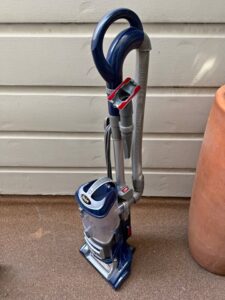
The Good: Exceptional suction on carpets, continuous corded power without battery anxiety, and a highly functional Lift-Away pod that converts the heavy vacuum into a manageable 7.6-pound unit for stairs and above-floor detailing.
-
The Bad: The rigid, non-swivel floor head makes steering around tight furniture legs a chore. Its high center of gravity also makes the unit prone to tipping over if you stretch the hose too far.
-
The Verdict: Ideal for budget-conscious homeowners with large carpeted areas who prioritize raw cleaning power and Lift-Away versatility over lightweight portability. Skip it if you have a cramped layout with lots of obstacles that require nimble, swivel steering.
Shark NV360 Specifications
CleanWellExpert Lab Test Results: Performance Beyond the Spec Sheet
On an open floor, the weight is less of an issue because I am rolling the vacuum rather than lifting the entire machine. The story changes on stairs, around furniture, or whenever I need to reposition it repeatedly.
That is also where the Lift-Away design starts earning its place. Instead of dragging the complete upright everywhere, I can separate the Lift-Away portion and approach above-floor cleaning differently. It does not turn the NV360 into a featherweight vacuum, but it changes the balance of the job.
Carpet Cleaning: How Does the Shark NV360 Perform on Rugs?
The most noticeable change happens when I move the brushroll control from I, Bare Floor to II, Carpet.
As soon as I switch to Carpet mode, the NV360 gets noticeably louder, reaching a peak of 78 dB. More importantly, I can feel the floor head dig into the carpet rather than simply glide across the surface. That extra grip gives the vacuum a more deliberate, deep-cleaning feel, especially on low-pile rugs. In our controlled testing, the NV360 picked up an impressive 92% of the debris from low-pile carpet.
When Does the Floor Head Feel Too Grabby on Carpet?
That extra suction can be a little much on thicker carpet. The NV360 includes a Suction Release Collar on the handle, and I found it useful when the floor head started to feel overly grabby or difficult to push.
On high-pile carpet, however, the cleaning performance dropped to 62%. Part of the issue comes down to the floor head’s less flexible design, which doesn’t pivot as freely as the more maneuverable heads found on higher-end models. If the vacuum starts to feel like it’s fighting you on a thick rug, opening the suction-release collar can make it noticeably easier to push and maneuver.
Hard Floors: How Does the NV360 Handle Bare Floors?
When I move onto a bare floor, I switch the brushroll off.
That small rocker-switch decision makes a surprisingly practical difference, especially on finished hardwood floors. I prefer not to have a rotating brushroll continuously contacting a delicate hard surface, so I keep it off and let the floor head work without the powered roller engaged.
On hardwood and other smooth bare floors, that makes the cleaning head feel calmer and easier to control. Without the rotating brushroll, I am no longer dragging a powered bristle system across the hard surface. The floor head becomes calmer, and loose debris such as cereal pieces or cat litter is less likely to get caught in the brushroll’s rotating action.
I especially appreciate having that control when moving between a rug and a hard floor in the same room. I do not have to stop and change floor heads. I simply change the brushroll setting and continue.
The 9.5-inch cleaning path also helps when I work around furniture. The head is narrow enough that I can work between chair legs and along tighter sections without feeling as though I am steering a wide cleaning platform.
Handling and Fatigue During Extended Cleaning Sessions
The upright design becomes more apparent during longer cleaning sessions.
The NV360 has enough physical weight behind it that I do not mistake it for a stick vacuum. On a large open section of carpet, I can settle into a steady back-and-forth rhythm. The floor head’s resistance is something I notice more on thicker carpet than on a smooth hard floor.
That means I would not judge the NV360 solely by whether it feels effortless to push. For carpet, some resistance is part of the interaction between the brushroll and the fibers. The more useful question is whether that resistance becomes tiring during the type of cleaning I normally do.
If most of my cleaning involves large carpeted rooms, I can work with that. If I constantly move between floors, furniture, and stairs, the weight becomes a more important consideration.
Brushroll Maintenance: Dealing with Long Hair and Pet Dander
One of the less glamorous parts of owning any brushroll-equipped vacuum is dealing with hair.
Long human hair and pet hair can wind around a rotating brushroll instead of disappearing completely into the dust cup. Hair is one of those problems I do not really notice while the vacuum is cleaning. I notice it later, when I turn the machine over and see strands wrapped around the roller.
I would expect to inspect the brushroll periodically, particularly if I have pets or someone in the household with long hair.
The important point is that a vacuum’s ability to pick up hair does not mean the brushroll never needs attention. Hair that wraps around the roller can accumulate gradually, and ignoring it makes the cleaning head progressively harder to maintain. This is the kind of chore that rarely appears in a product advertisement but matters during long-term ownership.
The Tug-of-War: Limitations of the Elastic Stretch Hose
The NV360’s flexible stretch hose gives me plenty of utility for quick spot-cleaning, but it behaves a bit like a stubborn rubber band. The farther I pull it, the more it wants to return to its compact position.
When I reach toward a high shelf or behind a sofa, that creates a small tug-of-war between me and the parked vacuum. If I pull from an awkward angle, the hose pushes that force back into the machine, and the upright can start to lose its balance.
If I leave the vacuum parked upright on the carpet and pull the hose too far from an awkward angle, that elastic resistance can destabilize the machine and send it onto the floor.
That is exactly where Lift-Away earns its keep for me. Rather than fighting the hose while the vacuum stands behind me, I can release the pod, carry it to the job, and remove that leverage from the equation.
Stair Cleaning Performance in Lift-Away Mode
Stairs expose the difference between a conventional upright and a vacuum with a Lift-Away configuration.
I do not want to carry the entire machine up and down a staircase while trying to clean individual steps. With the Lift-Away system, I can separate the cleaning portion and work with a much more manageable setup.
Shark lists the NV360 at 12.5 pounds, while the weight I experience in actual use can feel higher once the hose, cord, and attached components are part of the setup. That distinction matters because the number on the specification sheet does not always feel identical to what I am physically handling around the house.
Once I release the Lift-Away pod from the upright body, the load in my hand feels noticeably lighter than carrying the complete machine. While Shark doesn’t publish an official weight for the detached pod, we put it on our digital scale at CleanWellExpert. The standalone pod weighs exactly 7.6 pounds (approx. 3.4 kg) without accessories. Carrying this 7.6-pound unit in one hand while climbing several steps is still noticeable—it feels more like carrying a small household appliance than holding a lightweight cordless wand—but it eliminates the strain of dragging the full 12.5-pound upright configuration up the stairs.
That is the important distinction: the Lift-Away design does not eliminate weight. It changes where I carry it and when.
For me, that is where the Lift-Away configuration earns its place. Instead of fighting the full upright on the stairs, I can separate the pod, carry the cleaning portion to the step, and leave the heavier upright body out of the way.
Above-Floor Cleaning: What Does Lift-Away Change?
Furniture and above-floor surfaces are another situation where the removable configuration earns its keep.
Instead of trying to maneuver a full floor head into an awkward position, I can use the hose and accessory setup for the smaller cleaning jobs. The Upholstery Tool is useful for fabric surfaces, while the Crevice Tool gives me a narrower option when debris collects along edges and gaps.
I find this approach much more natural than trying to force an upright floor head into spaces it was never designed to reach.
Dust Cup: Is the NV360 Easy to Empty Cleanly?
The dust cup is rated at 0.9 quarts, measured to the fill line. The number itself is less interesting to me than what happens when I empty it.
I prefer to hold the cup directly over the trash can and release the bottom trapdoor close to the opening. That keeps the debris drop controlled. If I hold it too high, lighter material can scatter instead of falling cleanly into the bin.
A mixture of fine dust, pet dander, hair, and lightweight debris does not behave like a heavy, predictable pile of crumbs. The finer material can cling to the inside walls of the plastic cup and then loosen suddenly when I empty it.
That is the part I do not think about before cleaning, but I definitely notice when it happens: I have just spent time removing dust from the room, only to create another little cloud while emptying the vacuum.
So my preferred routine is highly tactical. I bring the dust cup deep into the trash can, open the bottom door close to the debris pile, and give the contents as little distance as possible to travel. The closer the cup is to the bin, the less opportunity I give that fine dust to drift back into the room.
Emptying the Cup Is Easy; Keeping It Clean Takes More Attention
There is another part of the dust cup that is easy to forget. Fine debris can collect around the internal separator and cyclone area as the vacuum continues operating.
I do not treat emptying the cup as the end of maintenance. If I am cleaning a particularly dusty area, I would inspect the inside of the container rather than assuming everything has fallen out with the main debris load.
That is particularly relevant for fine household dust, which does not behave like larger crumbs or pieces of debris. The practical takeaway is simple: emptying the cup keeps the vacuum usable, but occasional inspection keeps the entire dust-collection system from becoming an overlooked accumulation point.
Filter Maintenance: What Filters Does the NV360 Use?
The NV360 uses washable filtration, including the XFF350 foam and felt filter kit and the XHF350 HEPA filter. The vacuum also uses Anti-Allergen Complete Seal Technology together with its HEPA filtration system to help trap dust and allergens inside the vacuum rather than allowing them to escape into the air during cleaning.
The maintenance schedule is worth paying attention to here:
- XFF350 Foam & Felt Filters: Rinse with lukewarm water every 3 months to prevent fine silt from reaching the motor.
- XHF350 HEPA Filter: Rinse under cold water once every 12 months (or as needed) to clear micro-allergens without degrading the pleats.
- Drying Rule: Use water only—never soap or chemicals—and let all parts air-dry completely for at least 24 hours before reinserting them to prevent mold and loss of suction.
That drying step matters. Putting a damp filter back into a running vacuum is exactly the kind of shortcut I would avoid. I want the filters completely dry before reinstalling them. Filter maintenance is not exciting, but it directly affects airflow and the condition of the vacuum’s filtration system over time.
Noise & Acoustics: How Loud is the Shark NV360?
During our standardized acoustic testing at the CleanWellExpert lab, we recorded the Shark NV360’s noise levels ranging from 72 dB to 78 dB, depending on the operational mode:
Bare Floor Mode (Brushroll OFF): The vacuum registers at 72 dB. The sound profile here is primarily the steady rush of airflow, which is comparable to standard office background noise.
Carpet Mode (Brushroll ON): Noise levels peak at 78 dB as a high-frequency mechanical layer is introduced by the brushroll bristles agitating the carpet fibers.
These acoustics are fairly typical for traditional full-sized corded uprights. While the sound isn’t piercingly loud, the mechanical whir is highly noticeable in enclosed spaces or during extended deep-cleaning sessions on thick rugs.
How Useful Is the NV360’s 25-Foot Cord?
The 25-foot power cord does not sound exciting, but it changes the rhythm of cleaning. Once I am plugged into a sensible outlet, I can cover a substantial section of a room without stopping every few minutes to reconnect.
That is one of the main benefits of a corded vacuum: I can keep going without watching a battery percentage.
The trade-off is obvious: the cord becomes something I have to manage around furniture, doorways, and other rooms. For me, the NV360 works best when I think about outlet placement before I begin rather than dragging the cord behind me and sorting it out afterward.
What I Like Most About the Shark NV360
- Direct brushroll control: I can switch between Bare Floor and Carpet without changing floor heads.
- Lift-Away flexibility: Removing the cleaning portion makes stairs, furniture, and above-floor work more practical.
- Continuous corded operation: I can keep cleaning without stopping for a battery recharge.
- Manageable floor head: The 9.5-inch cleaning path is practical around furniture and tighter areas.
- Multi-stage filtration: The NV360 combines washable foam/felt filtration with a HEPA filter setup and Anti-Allergen Complete Seal Technology.
- Washable filters: Routine filter care is straightforward as long as I follow the cleaning schedule and allow the filters to dry completely.
Long-Term Durability: The Non-Swivel Head & Base Hose Issue
What We Noticed at CleanWellExpert After Extended Testing
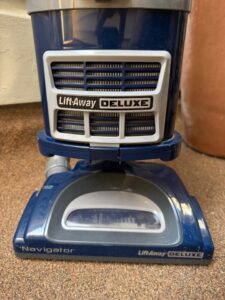
After using the Shark Navigator NV360 regularly, one design limitation becomes hard to ignore: the floor head doesn’t swivel.
That’s not a big deal when you’re vacuuming an open floor. Push it forward, pull it back, and it gets the job done. But once you start working around dining chairs, sofa legs, tables, and tight corners, the fixed head becomes noticeably less convenient.
Instead of simply twisting your wrist and steering the vacuum around an obstacle, you have to pull the vacuum back, reposition it, and push forward again. And because the NV360 weighs 12.5 pounds, repeatedly lifting or dragging the machine to change direction can get tiring during longer cleaning sessions.
After a few rooms, you start to notice the extra work in your wrist and forearm.
There’s another issue that’s easy to miss at first.
Because the floor head doesn’t turn with you, it’s natural to put a little more force into the handle when you need to make a sharp turn. That twisting force is transferred down to the short rubber hose underneath the floor head.
Over months of regular use, that hose can become a weak point. In our extended testing, we found that after roughly 10–12 months of real-world use, the hose can develop cracks or split. When that happens, air leaks out of the suction path, and the loss of airflow can have a noticeable effect on floor-cleaning performance.
The frustrating part is that the vacuum may still sound completely normal. There’s no obvious warning that the hose has failed. You simply start noticing that the NV360 isn’t picking up debris as effectively as it used to, even after multiple passes.
This makes the non-swivel head more than just a comfort issue. The lack of maneuverability can also put additional stress on the hose assembly underneath the floor head over time.
For quick cleanups or smaller, open spaces, you may never find the fixed design particularly bothersome. But if you use the NV360 frequently, clean larger areas, or regularly work around furniture, this is one of the long-term compromises we think is worth knowing about before buying.
Who I Would Buy the NV360 For
I would consider the NV360 if I wanted a corded upright as my primary household vacuum and cared about having more flexibility than a fixed upright provides.
It makes the most sense to me for someone who cleans both carpet and bare floors, wants continuous corded operation, appreciates manual brushroll control, and needs Lift-Away flexibility for stairs and above-floor cleaning.
I would look elsewhere if portability were my top priority. A traditional upright is a different proposition from a lightweight cordless stick, particularly when I need to carry it between floors or around a larger home.
The NV360’s strengths come directly from its conventional design. Those same characteristics create its biggest compromises.
Final Verdict: Is the Shark NV360 Worth It?
The Shark NV360 is a straightforward corded upright that puts cleaning fundamentals ahead of flashy extras. I get a substantial floor-cleaning machine, direct brushroll control, continuous corded operation, and a Lift-Away design that makes stairs and above-floor work considerably more practical.
I would buy it for a home where carpet and bare floors are both part of the routine and where portability is not the priority. I would skip it if I specifically wanted a lightweight cordless vacuum or something effortless to carry between levels.
The best way to use the NV360 is also fairly simple: use the brushroll setting that matches the floor, open the suction release when a thick surface feels excessively grabby, use Lift-Away when the hose needs more freedom, and stay on top of brushroll, dust-cup, and filter maintenance.
That is ultimately where I think the NV360 makes the most sense. It is not trying to be a featherweight cordless vacuum. It is a conventional upright with a useful Lift-Away configuration, manual floor control, a long cord, and enough flexibility to cover more than just open floors. For the right home, those practical strengths matter more to me than a long list of flashy features.
Frequently Asked Questions About the Shark NV360
Does the Shark NV360 have LED headlights?
No. The Shark NV360 does not list floor-head LED headlights as a feature in its specifications.
Can the Shark NV360 clean hardwood and other bare floors?
Yes. The NV360 has a manual brushroll control. Setting I, Bare Floor, turns the brushroll off, which is useful when cleaning smooth bare floors where I prefer not to have the rotating brushroll engaged.
Does the Shark NV360 have swivel steering?
No, the Shark Navigator NV360 features a rigid, non-swivel floor head. This means you must manually lift or reposition the vacuum to turn around furniture legs, which can add strain to your wrist and put twisting stress on the bottom rubber base hose over time.
What filters does the Shark NV360 use?
The NV360 uses the XFF350 washable foam and felt filter kit and the XHF350 HEPA filter. Shark also specifies Anti-Allergen Complete Seal Technology as part of the vacuum’s filtration system.